

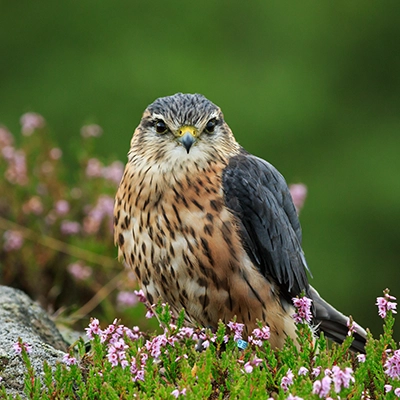
Our smallest falcon, the tiny Merlin, makes up for its lack of size with sheer determination and lack of fear. Perhaps best known as a lady’s falcon in Medieval times, Merlin are specialist in catching birds and were popular for catching larks. It is definitely a bird that lives up to the ‘dashing’ falcon label!
Key Facts
Common name: Merlin
Scientific name: Falco columbarius
Habitat: Open upland and moorland habitats, open coniferous woodland, coastal areas, farmland and lowland heath
Diet: Small birds such as Meadow Pipit and Skylark but will take larger prey such as Starling and wading birds
Size: Average 28cm, wingspan 56cm. Females (230g) larger than males (180g)
Status: Resident breeder. Passage/winter visitor
Population size: 1,150 pairs
Conservation status: RED (Due to historical population and range decline).
Appearance
The Merlin is the smallest bird of prey found in the UK. It is one of the four falcons in the UK along with Peregrine, Hobby, and Kestrel. It has a much shorter, squarer tail and broader shorter wings than the other falcons but still has that typical pointed wing shape synonymous with falcons. Males are slate grey above, similar in colour to Peregrine, but lacking the paler rump area of that species, and with a broad, black tail band. Their wing tips are darker with white spots. Underneath they are fairly pale, with heavy streaking on the chest and belly, strongly barred wings and dark-tipped tail. Females and young birds are browner, with a mixture of dark and light brown patterning. The wings are broad-based and short but very pointed, and the tail is proportionally long.
Lifespan
The average age in the wild is 3 years. Adults have a 62% year-to-year survival rate. First year survival is 23%. The oldest known wild bird was almost 13 years old (ringing recovery).
Nesting
British birds most commonly nest in simple scrapes on the ground in amongst dense heather, or on rock outcrops, but tree nesting in old corvid or raptor nests is well-recorded and some birds will even nest on buildings within its wider world range. As with many birds of prey the female does most if not all the incubating.
Number of eggs: 4-5
Incubation: 30 days
Fledging time: 28-31 days
Habitat and Distribution
During the breeding season, Merlin is a species of open upland and moorland habitats, although it will breed in open coniferous woodland as well. During the winter it is found over a much wider range of habitats including coastal areas, farmland and lowland heath. Breeding season distribution is northern and western Britain (although it is scarce away from coastal areas in Ireland) including offshore islands. Merlin can turn up pretty much anywhere in winter, although it is never a common bird.
Merlin are found all around the northern hemisphere breeding across norther North America, Europe and northern Asia, across to Japan and northeastern Russia. Many populations are migratory, and birds winter in North and Central America, and even into South America, most of mainland Europe and North Africa, Middle East, the Indian subcontinent and China. There are a number of different sub-species across its range including two in Europe. The British breeding birds share characteristics of both sub-species.
Movements
Many of our breeding birds move into the lowlands once the breeding season is over, usually within 100 km of their natal areas, although a few will cross into western and southern Europe, with some individuals reaching southern France or Spain. Britain is an important wintering area for Icelandic breeding Merlin and many of the individuals encountered in winter will be from this population.
Feeding
Merlin specialise in hunting birds, usually in flight. Unlike Kestrels, which invariably hover looking for mammals or invertebrate prey, Merlins chase their prey in agile, high-speed pursuits. Small passerines such as Meadow Pipit and Skylark are favourite targets, although they will tackle larger prey such as Starling and wading birds are readily tackled. Merlin fly low and fast, aiming to flush their prey into the air, and have been recorded hunting cooperatively, with one bird flushing prey towards their mate. Merlins have been recorded hunting using a distinctive clipped flight style, possibly appearing to other birds less like a falcon and more like the similarly sized Mistle Thrush, allowing closer approach before their true identity is discovered.