

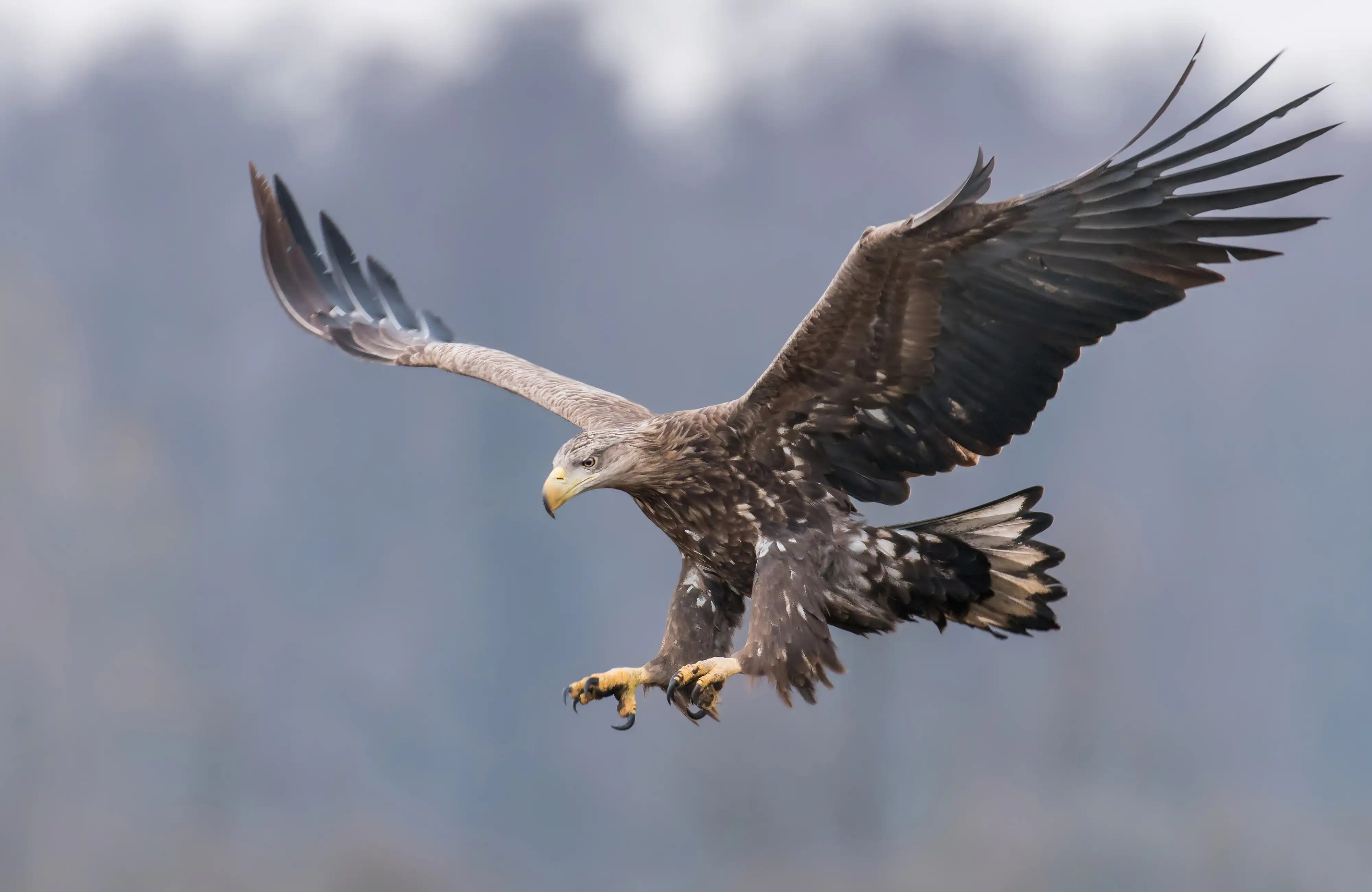
White-tailed Eagles have been described as a flying barn door with broad parallel-edged wings, and short tail making this the largest and most imposing British bird of prey. Now a focus of eco-tourism and a familiar star of wildlife photographs, White-tailed Eagle has a sad history in this country.
Also known as Sea Eagle, the local name of Erne was used in northern and western Britain where historical populations had retreated to. It became a species of wild, coastal areas but even here it was wrongfully accused of taking lambs, and persecution was heavily supported. By 1916 just one female (an albino) was present on Skye and even she was eventually killed.
In 1975 began one of the most successful reintroduction programmes, albeit one that took many years to secure White-tailed Eagles once more as a part of our natural fauna. Norwegian chicks were reared in holding pens on the Isle of Rhum in the Inner Hebrides, before being released with supplementary feeding provided. It was another 10 years before the first chick was raised, as these long-lived birds reached breeding age and slowly began to learn to rear chicks to fledging. Subsequent additional releases have supplemented the population and numbers are now, slowly, rising.
Archaeological discoveries, and observations of eagles in Europe as the population rises there as well, show that far from being ‘Sea Eagles’ these are birds equally at home in lowland wetlands and marshes. Wandering young birds, both from the British population but also from Scandinavia and the Netherlands, turn up along the East coast each winter and there is a hope that some of these birds may settle.
Key Facts
Common name: White-tailed Eagle
Scientific name: Haliaeetus albicilla
Habitat: Coastal sites
Diet: Fish and sea birds
Size: Average 80cm, wingspan 220cm. Weight averages 4.3kg in males, 5.5kg in females.
Status: Re-introduced, resident breeder. Passage visitor.
Population size: 123 pairs
Conservation status: AMBER listed
Appearance
The White-tailed eagle has brown and white plumage with pale head and neck area. Its broad wings with distinctive finger like ends are the biggest feature to distinguish it from any other bird of prey. Adult birds have white tail feathers and chunky yellow beaks. In flight their wings are flat not ‘V’ shaped which is a good way to tell them apart from a Golden Eagle, along with the sheer size of them.
Lifespan
Average lifespan is estimated at 12 years. Adults have 70% year-to-year survival. First year's survival is low, and the oldest known wild bird was 33 years old (ringing recovery).
Nesting
White-tailed Eagles nest in large stick nests, often in the fork of a large tree, where available, although they will nest on cliffs and crags. Nests are enormous, sometimes measuring several metres across and up to two metres deep. Nests are usually repaired and added to each year.
Number of eggs: 2
Incubation: 38 days
Fledging time: 70-75 days
Habitat and Distribution
Currently this is a species of well-known localities. Certain islands such as Mull and Skye offer excellent chances of encountering this species. Any of the Scottish Atlantic islands can be visited by White-tailed Eagles, and breeding occurs on a number of them. Successful breeding occurred on Hoy, Orkney for the first time in 2018 and there are a number of additional reintroduction options being considered, including some on the lowlands. This is still very much a bird of coastal sites but wintering birds are as likely to be encountered inland on marshes or other, open, habitats.
Movements
British White-tailed Eagles are relatively sedentary although as with all large, long-lived birds of prey, young birds will explore, travelling sometimes significant distances from their natal site and even leaving the UK before, usually returning to breed not far from their place of birth. As the population is currently so low, there are so many potential breeding territories available.
Feeding
As with many birds of prey, White-tailed Eagles are adaptable and take opportunities as they arise, but fish is an important food item, alongside seabirds. Indeed, in the early days of the Rhum reintroduction young, inexperienced eagles were targeting the numerous Fulmars around the coast, before they learned of the Fulmar’s ability to vomit copious amounts of very sticky fish oil, which led to several youngsters becoming significantly oiled and dying. Other birds are a favourite food item and the range of species taken is large, with birds up to the size of a Grey Heron being taken, although there are records of even Mute Swans being caught and killed.
Mammals may feature in the diet, but these are usually secondary and are invariably either Rabbits and Hares, or carrion. Carrion can be an important part of the diet, especially in winter.