

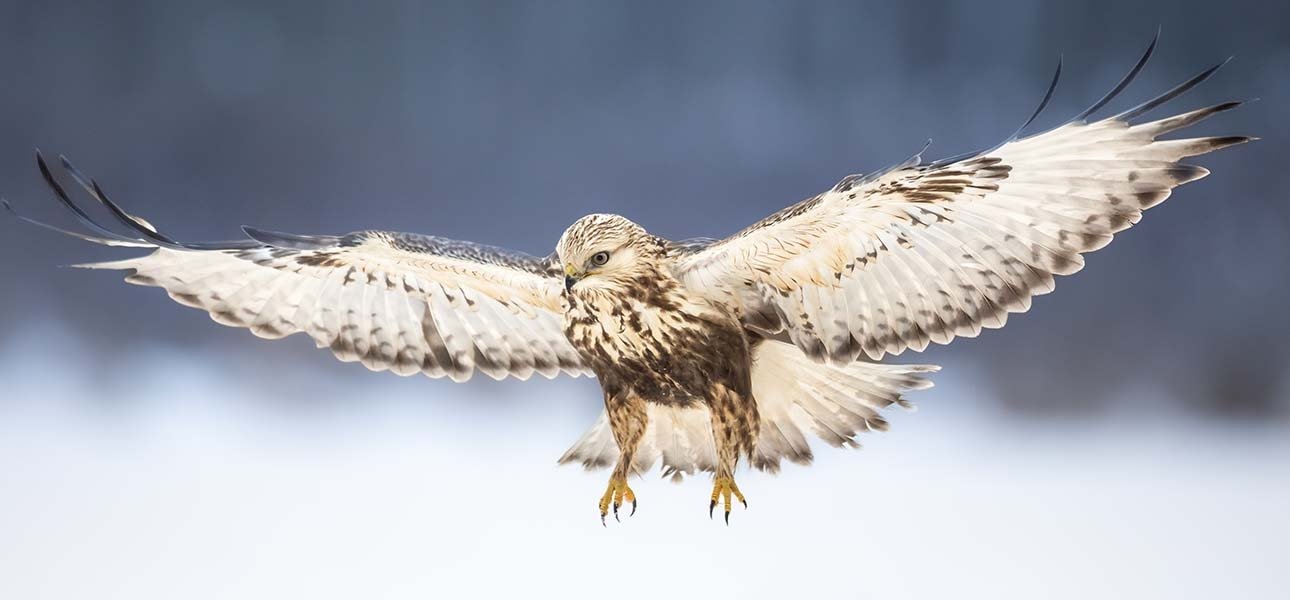
One of our less familiar birds of prey, and the only regularly occurring one, is a winter migrant to the UK. Rough-legged Buzzards are birds of northern countries, found right around the Northern Hemisphere in North America, Europe and Russia, although absent from Iceland and Greenland. During the breeding season they live over bogs and mountainous heathland areas, or in clearings in coniferous woodland. Harsh winter conditions mean that most move south, with birds arriving in the UK in varying numbers each year due to both weather conditions and the cyclical nature of numbers of their rodent prey. Rough-legged Buzzard are most likely to be encountered on the east coast and the northern islands of Shetland and Orkney.
Key Facts
Common name: Rough-legged Buzzard
Scientific name: Buteo lagopus
Habitat: Winter visitors to the British east coast
Diet: Small rodents and birds
Size: Average length 55cm, wingspan 135cm. Females (1.3kg) larger than males (900g)
Status: Winter migrant
Population size: Varying numbers. Usually up to 20 birds in a year, occasionally 100 or more
Conservation status: Least Concern
Appearance
Similar in size to Common Buzzards, Rough-legged Buzzards have proportionally longer wings, and present a different silhouette, appearing at times more eagle-like. They are very likely to be seen hovering, as this is their favoured hunting technique.
Plumage is similar to Common Buzzard, although a white-based tail and dark belly patch are helpful features where present.
Lifespan
Not known.
Habitat and Distribution
Holarctic distribution. Nests in Arctic habitats, winter visitor to UK.
Movements
Highly mobile, responding to weather conditions and abundance and distribution of prey species.
Feeding
They specialise in hunting small rodents, especially voles and lemmings, but they are adaptable and will target birds when rodent numbers are low. Usually hunts either from a perch, or during prolonged hovering flights.