

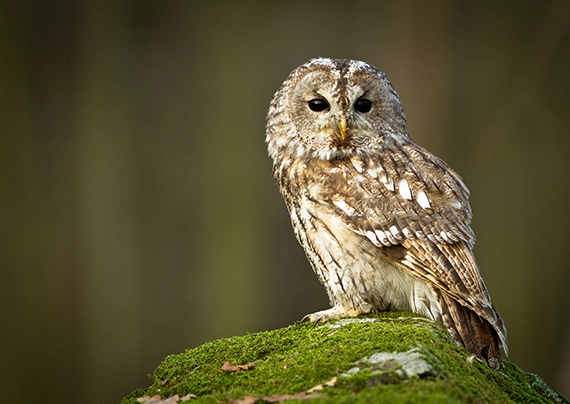
Tawny Owl is possibly, along with Barn Owl, our most familiar owl. Children grow up knowing the ‘tu-wit-tu-woo’ call of Tawny Owl, but this is actually not the call of one owl, as is often believed. Tawny Owl is one of the few British birds where the pair duet. The female starts with a harsh ‘kee-vik’ and her mate answers with a softer tremulous hoot ‘who-ooooo’. Despite being a common bird, Tawny Owls are rarely seen, as they are highly nocturnal. Often the only sight is a stocky blunt-headed, round-winged silhouette slipping from tree to tree, or sitting on top of a chimney. Tawny Owls roost, usually well-hidden, during the day and if they are located by small birds, they will be mobbed constantly, by Blackbirds, Jays and other noisy birds, often giving away their location and, occasionally, driving them from their roost site in broad daylight.
Key Facts
Common name: Tawny Owl
Scientific name: Strix aluco
Habitat: Woodland, farmland, villages and even urban areas
Diet: Small rodents, small birds, small mammals, earthworms
Size: Average 38cm, wingspan 99cm. Weight averages 520g (female) which is bigger than 420g (male).
Status: Resident breeder.
Population size: 50,000 pairs.
Conservation status: AMBER (Due to recent breeding decline).
Appearance
Tawny Owls are perfectly camouflaged with their surroundings. Their brown and grey streaked plumage allows them to blend in with the surrounding woodland. When sat in a hollowed tree they blend in seamlessly with the trunk. The Tawny Owl has a rounded head, large eyes, and a hooked beak which gives it the iconic look.
Lifespan
The average age in the wild is 4 years. Adults have a 74% year-to-year survival rate. First year survival is just 30%. The oldest known wild bird was almost 23 years and 6 months old (ringing recovery).
Nesting
Tawny Owls are hole nesters, most usually found in tree holes, including vertical ‘chimneys’ where trees have snapped off. They will take to nest boxes designed for them with a vertical chamber. Only the female incubates the eggs.
Number of eggs: 2-3
Incubation: 30 days
Fledging time: 35-39 days
The birds remain in pairs throughout the year, and breeding activity begins early, in late winter. Chicks leave the nest well before they can fly, ‘branching’ into nearby trees, from where the adults continue to provision them, and they beg continuously. If a chick falls to the ground, they are able to clamber back up into the trees using their very sharp claws to help them walk back up the tree trunk, flapping their tiny wings as they go.
Later in the season and on into autumn and early winter the young are looking for their own territories after having been noisily chased from their birth sites by their parents. Each existing territory they pass through will elicit much calling, shrieking and hooting. This is a dangerous time for the young owls, and many will die, driven from hunting grounds by resident birds before they reach their first year.
Habitat and Distribution
Tawny Owls are very much birds of woodland, especially broad-leaved woodlands, but they are also very adaptable and will be found wherever there are suitable trees, such as farmland, villages and even urban areas. Within England, Scotland and Wales they can be found anywhere except for high mountains, or other tree-less habitats. They are absent from some of the offshore islands such as Orkney, Shetland, Hebrides and Isle of Man and the species is also completely absent from Ireland. Tawny Owl, despite its familiarity, is a highly nocturnal species and is difficult to monitor using standard bird monitoring methods. Periodic specific surveys are run, concentrating on the well-known calls and hoots.
Movements
With only one exception (Long-eared Owl), owls are known for not being migratory, but Tawny Owl possibly ranks as one of our most sedentary birds. Once a bird has found a territory, which is likely to be only a few kilometres from their natal site, it is unlikely to move for the rest of its life. When first expelled from their parent’s territory in late summer birds will wander in search of the nearest available site but it is believed that the very few longer ‘journeys’ by ringed Tawny Owls have happened with the inadvertent help of vehicles – as all have been recovered dead on roads. It is almost certainly this lack of dispersal that has led to the species’ absence from many of our offshore islands, although some islands, such as Islay, do have the species.
Feeding
Small rodents are usually considered to be the Tawny Owls main prey, but Tawnies are very efficient and adaptable hunters. Urban and suburban birds take a large number of other birds and Tawny Owls are capable of tackling some surprising species such as other owls, Mallards and even gulls. Farm and urban owls make take rats and rabbits, and some birds specialise in frogs and even fish. When times are hard earthworms can make up a large proportion of the diet, although their remains are not found in pellets, and on rare occasions Tawny Owls have been recorded taking carrion.